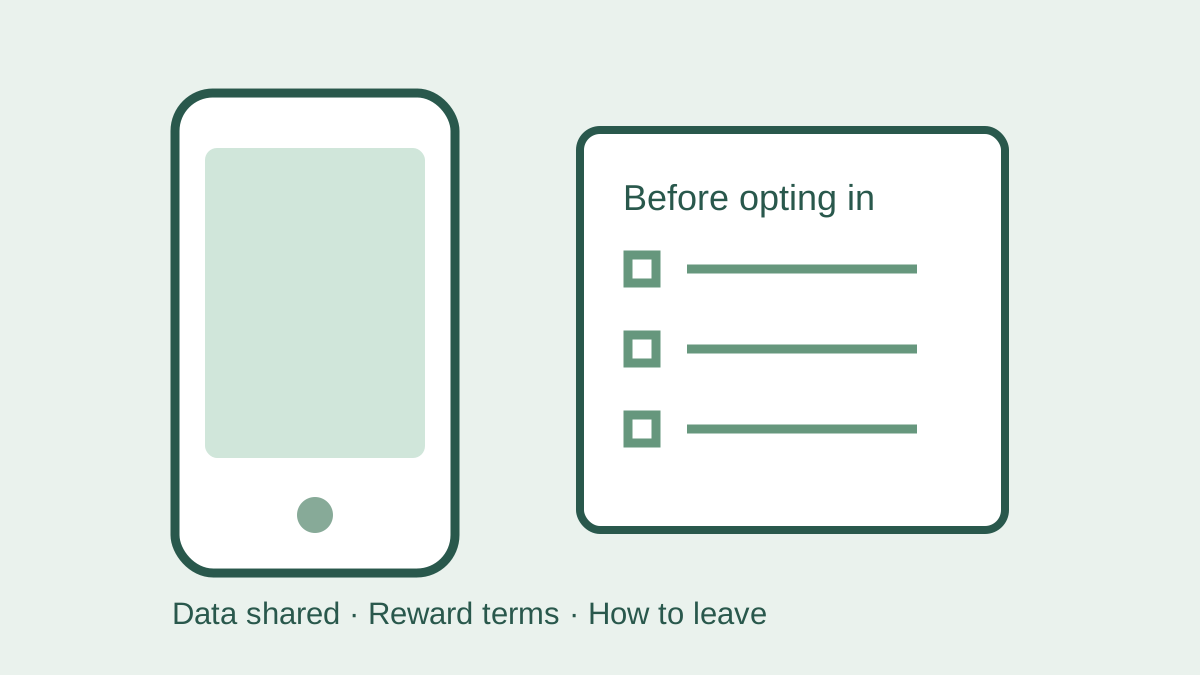
Some research panels offer rewards for allowing a browser extension or app to collect information in the background. The activity may require less attention than answering a questionnaire, but it is not cost-free: you are sharing data, using a device and accepting the program's terms. Compare the reward with the information collected and the rules for leaving before opting in.
Ordinary surveys are different. They generally require you to qualify and actively answer questions. Watching a video or completing an offer also takes attention, even when a rewards site describes it as an easy task.
The main types of background research
Internet meters run on an eligible device and collect information about digital activity. What is collected, how frequently a device must be active and which devices qualify depend on the provider. Read the actual notice for each device rather than assuming an app and a desktop extension have identical permissions.
Browser extensions may offer a shortcut to a panel, notifications, data collection or several of these features. A notification extension is not automatically the same as a measurement tool. Check the permissions requested during installation and the provider's privacy explanation before enabling it.
Purchase-data connections can involve linking an account or sharing transaction information. Check which accounts are supported, what the connection can access, and how to revoke it. Do not give a password to a person claiming to be support; use the provider's documented connection process if you decide to proceed.
Video and offer activities are usually active tasks rather than background measurement. Check whether a particular video, game or offer is actually available in your account, what counts as completion, and whether it involves a purchase or subscription. Availability can change, so a historical list of video walls is not proof that a current reward exists.
Two examples to investigate
Survey Junkie's ways to participate page distinguishes regular surveys from its optional Surf to Earn community. The company says the latter shares digital activity such as searches, websites visited, shopping activity and ads seen. It describes participation through a browser extension or an opt-in on its mobile app. Read the applicable privacy policy for the device and location you use before deciding whether that trade-off is acceptable.
SurveySavvy's SavvyConnect participation requirements describe an incentive program tied to installing the app and meeting the requirements for particular devices. Its consent information explains how to withdraw consent, including uninstalling the software and contacting its privacy team. Check the current device, country and activity terms directly; an installation alone is not proof that a particular reward has been credited.
These are examples of disclosed programs, not personal endorsements or proof that any reader will receive an offer. Reward availability and participation rules can differ by account and region.
Work out the exchange before signing up
Start with four questions. What information may be collected? Which devices or accounts are involved? What must remain active to earn a reward? How can you stop participation and request information about data already collected? A privacy policy may describe collection more broadly than a short marketing page, so read both.
Then check the reward catalogue and redemption conditions. A stated points balance is useful only if you can meet the minimum and use a reward in your country. Look for expiry rules, inactivity conditions and whether an incentive is cash, a gift card or an entry in a drawing. A prize draw is a chance to win, not guaranteed payment.
Consider device battery use, network activity and any effect on other software. A program that runs in the background may still need updates or troubleshooting. If a research app conflicts with a survey or another service, follow the provider's terms and seek support; do not disguise your connection to get around restrictions.
How much can you earn?
There is no dependable amount to expect across all programs. It depends on the specific offer, your eligibility, the permitted devices and whether the activity satisfies the program's requirements. Historical sign-up bonuses and payment figures can expire. Read the offer currently shown by the provider and do not treat it as a guaranteed monthly income.
Before installing anything, compare the value you could actually redeem with the privacy and device commitments. If you are uncomfortable sharing the listed information, an active survey or a different type of research may be a better fit, even if it takes more time.
Leaving a program
Find the program's cancellation instructions before you join. Disabling an extension or uninstalling an app can stop that software running, but it does not necessarily delete information already collected or cancel the underlying account. Check the provider's privacy notice for opt-out, account closure and data-request steps. Save any confirmation and review the effect on pending rewards.
For a wider comparison of savings, investment and data-sharing offers, see our guide to passive-income apps. Each model has a different cost and reward; none should be treated as risk-free or automatic income.